
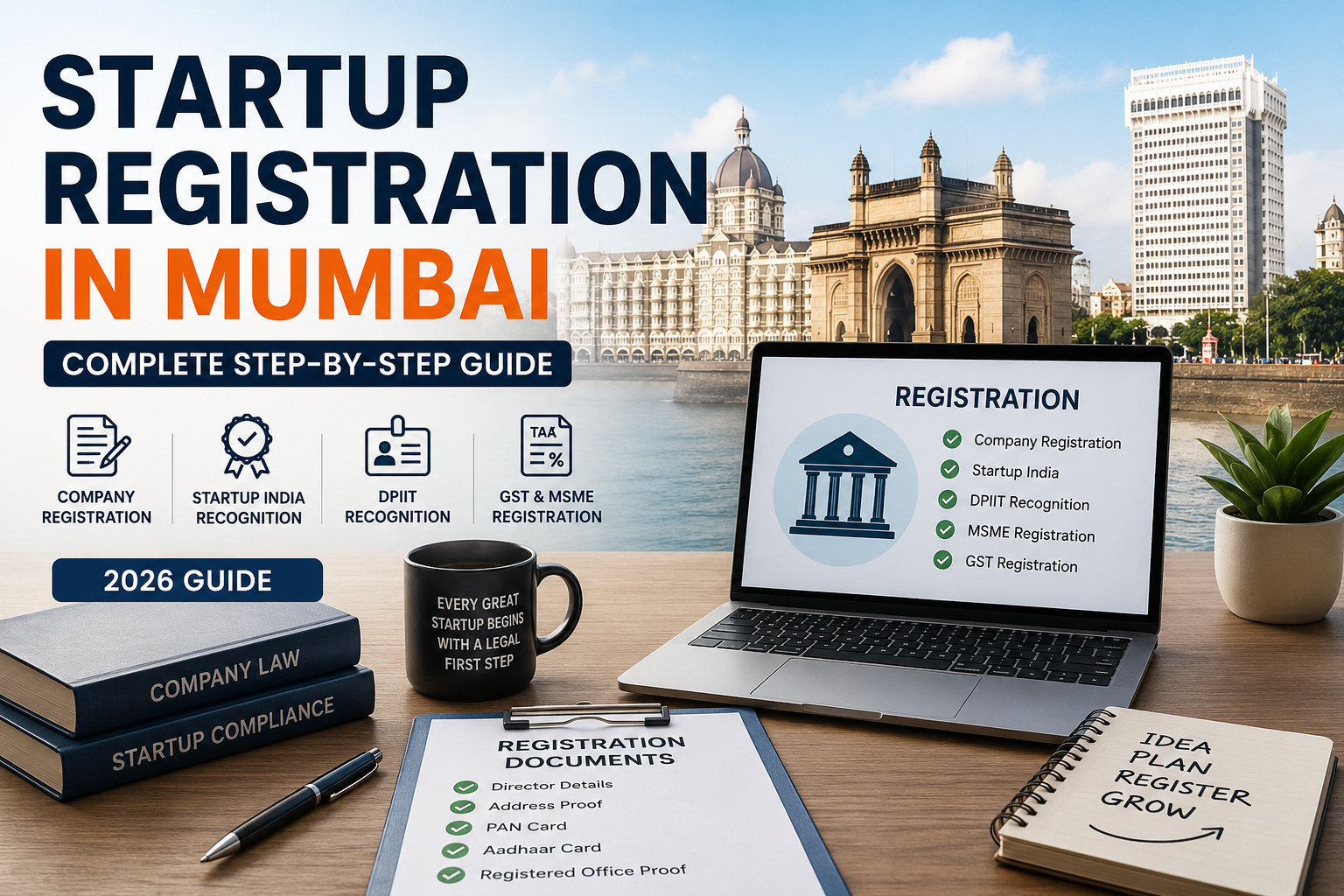
Learn how to register a startup in Mumbai with this complete 2026 guide covering company registration, Startup India, DPIIT, MSME, GST, costs, and required documents.
Every successful startup begins with a great idea, but turning that idea into a legally recognized business is the first real milestone. Whether you’re building a technology platform, launching a D2C brand, opening a consultancy, or developing an innovative product, startup registration in Mumbai is an essential step that lays the foundation for long-term growth.
Many aspiring entrepreneurs delay registration because they believe the process is complicated, expensive, or filled with legal hurdles. In reality, India has made significant progress in simplifying business registration through digital platforms and startup-friendly initiatives. Today, most registration-related processes can be completed online with proper documentation and professional guidance.
Mumbai, being India’s financial capital, attracts thousands of entrepreneurs every year. The city offers access to investors, customers, mentors, and business opportunities, making it one of the best places to launch a startup. However, operating without the correct legal structure can create challenges when opening a bank account, raising funds, signing contracts, hiring employees, or applying for government benefits.
That’s why choosing the right business structure and completing the required registrations should be one of your first priorities.
In this guide, you’ll learn everything you need to know about registering a startup in Mumbai—from selecting the right legal entity to obtaining Startup India recognition, registering under MSME, understanding GST requirements, estimating costs, and avoiding common mistakes.
Whether you’re a first-time founder, freelancer planning to scale, or an experienced entrepreneur launching a new venture, this guide will help you understand the registration process in a simple and practical way.
read also- Best SIP Plans for Beginners in India 2026 – Smart SIP Strategy for Long-Term Wealth Creation
Why Startup Registration Is Important
Many entrepreneurs begin by testing their business idea informally. While this approach works during the initial validation stage, operating without proper registration becomes risky as the business grows.
Registering your startup offers several important advantages.
Builds Business Credibility
Customers, investors, banks, and corporate clients are more likely to trust a legally registered business than an unregistered one. A registered entity demonstrates professionalism and commitment.
Makes Fundraising Easier
Most angel investors, venture capital firms, and financial institutions prefer investing in legally registered companies. If you plan to raise funds in the future, registration is almost always necessary.
Opens a Current Bank Account
Business transactions should ideally be separated from personal finances. Registration enables you to open a business current account, improving financial management and accounting.
Protects Founders
Depending on the legal structure you choose, registration can provide limited liability protection. This helps safeguard personal assets from certain business-related risks.
Improves Business Opportunities
Many government tenders, corporate contracts, startup programs, and incubators require businesses to be legally registered before applying.
read also- How to Improve CIBIL Score Fast: 10 Smart Fixes That Work
Choosing the Right Business Structure
One of the most important decisions you’ll make before registration is selecting the appropriate legal structure. The right choice depends on factors such as the number of founders, investment plans, liability, taxation, and future growth.
Below are the most common business structures for startups in Mumbai.
Comparison Table: Sole Proprietorship vs LLP vs Private Limited Company
| Feature | Sole Proprietorship | Limited Liability Partnership (LLP) | Private Limited Company |
|---|---|---|---|
| Best For | Freelancers, Consultants, Small Businesses | Professional Firms, Agencies, Small Startups | Scalable Startups, Tech Companies, Fundraising |
| Minimum Owners | 1 | 2 Partners | 2 Directors & 2 Shareholders |
| Separate Legal Entity | ❌ No | ✅ Yes | ✅ Yes |
| Limited Liability | ❌ No | ✅ Yes | ✅ Yes |
| Ease of Registration | ⭐⭐⭐⭐⭐ Very Easy | ⭐⭐⭐⭐ Easy | ⭐⭐⭐ Moderate |
| Compliance Requirements | Low | Moderate | High |
| Fundraising Capability | Very Limited | Limited | Excellent |
| Suitable for Investors | ❌ No | ⚠️ Limited | ✅ Yes |
| Business Credibility | Moderate | High | Very High |
| Taxation | Personal Income Tax | LLP Tax Rates | Corporate Tax Rates |
| Business Continuity | Depends on Owner | Better | Excellent |
| Government Startup Benefits | Limited | Available (if eligible) | Available (if eligible) |
| Ideal for Long-Term Growth | ❌ Limited | ✅ Good | ✅ Excellent |
Quick Recommendation
| If You Are… | Recommended Structure |
|---|---|
| Freelancer or Individual Professional | Sole Proprietorship |
| Two or More Professionals Starting a Business | LLP |
| Planning to Build a Scalable Startup | Private Limited Company |
| Looking for Angel or VC Funding | Private Limited Company |
| Launching a SaaS, AI, FinTech, or Tech Startup | Private Limited Company |
| Running a Consulting or Service-Based Business | LLP |
💡 Pro Tip
Don’t choose a business structure only because it’s cheaper to register. Choose one that aligns with your long-term goals, funding plans, ownership structure, and expected growth. Changing your business structure later can involve additional costs, paperwork, and compliance.
read also- Best Work From Home Jobs in India With High Income
1. Sole Proprietorship
A sole proprietorship is the simplest business structure and is generally suitable for freelancers, consultants, small retailers, and individual service providers.
Advantages
- Easy to start.
- Low compliance requirements.
- Minimal registration cost.
- Complete control over business decisions.
Limitations
- No separate legal identity.
- Unlimited personal liability.
- Difficult to attract investors.
- Limited scalability.
This structure is suitable for individuals testing a business idea before expanding.
2. Partnership Firm
If two or more people plan to run a business together, a traditional partnership can be an option.
Advantages
- Easy to establish.
- Shared investment.
- Shared responsibilities.
- Lower compliance than companies.
Limitations
- Partners generally have unlimited liability.
- Ownership disputes may arise without a well-drafted partnership deed.
3. Limited Liability Partnership (LLP)
An LLP combines the flexibility of a partnership with limited liability protection.
It has become a popular choice among consultants, agencies, professional service firms, and small startups.
Advantages
- Limited liability.
- Separate legal identity.
- Better business credibility.
- Moderate compliance.
Best For
- Consulting firms.
- Marketing agencies.
- IT service providers.
- Professional firms.
- Small technology startups.
4. Private Limited Company
For startups planning to scale, raise investments, or build a large business, a Private Limited Company is generally the preferred structure.
This is also the structure most commonly preferred by angel investors and venture capital firms.
Advantages
- Separate legal identity.
- Limited liability.
- Easier fundraising.
- Better brand credibility.
- Suitable for long-term growth.
Best For
- Technology startups.
- SaaS companies.
- FinTech startups.
- AI startups.
- Healthcare startups.
- Consumer brands.
- Businesses planning to raise external funding.
Although compliance requirements are higher than those of a sole proprietorship or LLP, the long-term advantages often outweigh the additional responsibilities.

Which Business Structure Should You Choose?
There is no one-size-fits-all answer.
If you’re starting alone with a small budget and want to validate an idea, a Sole Proprietorship may be sufficient.
If you’re building a professional services business with one or more partners, an LLP can be a practical choice.
If your goal is to create a scalable startup, attract investors, and build a recognizable brand, a Private Limited Company is generally the most suitable option.
Choosing the right structure at the beginning can save significant time, money, and administrative effort as your business grows.
Excellent. Ab isi article ka Part 2 continue karte hain. Yeh same article ka continuation hai.
read also- How to Start a Blog in India and Earn Money Fast
Documents Required for Startup Registration in Mumbai
Before beginning the registration process, make sure all required documents are ready. Having the correct paperwork in advance helps avoid unnecessary delays and makes the application process much smoother.
Although the exact requirements may vary depending on the business structure, most startups will need the following documents.
Identity Proof
Every founder or director must provide a valid government-issued identity proof such as:
- Aadhaar Card
- PAN Card
- Passport (if applicable)
- Voter ID (in some cases)
Among these, PAN and Aadhaar are the most commonly required documents for Indian founders.
Address Proof
Each director or partner should also submit a recent address proof, such as:
- Aadhaar Card
- Passport
- Driving Licence
- Utility Bill
- Bank Statement
The address proof should generally be recent and clearly display the applicant’s name and address.
Registered Office Address Proof
Every company must have a registered office address.
The following documents are generally accepted:
- Electricity Bill
- Property Tax Receipt
- Water Bill
- Rent Agreement (if the property is rented)
- No Objection Certificate (NOC) from the property owner, where applicable
A startup does not necessarily need a commercial office. In many cases, a residential address can be used as the registered office, subject to compliance with applicable rules.
Passport-size Photographs
Recent passport-size photographs of all directors or partners may be required for documentation and verification purposes.
Email Address and Mobile Number
Every director should have an active:
- Email ID
- Mobile Number
Most official communications and OTP-based verifications are completed through these.
Step-by-Step Startup Registration Process in Mumbai
Many first-time entrepreneurs assume company registration involves lengthy paperwork and multiple office visits. Fortunately, much of the process can now be completed online.
Here’s how it typically works.
Step 1: Decide Your Business Structure
The first step is selecting the appropriate legal entity.
For example:
- Sole Proprietorship
- Partnership Firm
- LLP
- Private Limited Company
Most startups planning future investment choose a Private Limited Company, while freelancers and consultants often prefer a Sole Proprietorship or LLP.
Choosing the right structure from the beginning helps avoid unnecessary restructuring later.
read also- Affiliate Marketing India Guide That Can Unlock Huge Earnings
Step 2: Obtain a Digital Signature Certificate (DSC)
Since company registration is completed electronically, directors are required to digitally sign various documents.
A Digital Signature Certificate (DSC) functions like an electronic signature and is used while submitting registration forms.
Without a DSC, online incorporation documents cannot be signed.
Step 3: Apply for Director Identification Number (DIN)
Anyone who wishes to become a director of a company must obtain a Director Identification Number (DIN).
The DIN acts as a unique identification number for company directors and remains valid throughout their lifetime.
Step 4: Reserve the Company Name
Choosing a company name is more important than many founders realize.
Your company name should:
- Be unique.
- Not resemble an existing registered company.
- Avoid trademark conflicts.
- Reflect your business identity.
It’s a good idea to prepare multiple name options because your first choice may not always be approved.
Step 5: File Incorporation Documents
Once the name is approved, the incorporation documents are submitted to the concerned authorities.
These documents generally include:
- Director details
- Registered office information
- Company objectives
- Shareholding pattern
- Required declarations
Accuracy at this stage is extremely important because mistakes can delay the registration process.
Step 6: Receive the Certificate of Incorporation
After successful verification, the company receives its Certificate of Incorporation.
This document officially confirms that your company has been legally incorporated.
At this point, your startup becomes a recognized legal entity.
Step 7: PAN and TAN Allotment
During incorporation, the company is generally allotted:
- Permanent Account Number (PAN)
- Tax Deduction and Collection Account Number (TAN)
These are essential for taxation, banking, and other statutory compliances.
Step 8: Open a Business Current Account
Once incorporation is complete, the next step is opening a business current account.
Avoid using your personal savings account for business transactions.
A dedicated business account makes accounting, tax filing, and financial management much easier.
Startup India Registration
Registering a company and obtaining Startup India recognition are two different processes.
Many entrepreneurs mistakenly believe that incorporating a company automatically makes it a Startup India-recognized startup. This is not correct.
Startup India recognition is a separate process designed to support eligible innovative businesses.
Recognized startups may become eligible for various benefits, subject to meeting the applicable criteria.
Some potential advantages include:
- Easier participation in government programs.
- Access to startup networking opportunities.
- Eligibility for certain support schemes.
- Recognition within the startup ecosystem.
However, not every newly registered company automatically qualifies. Applicants must satisfy the prescribed eligibility conditions.
DPIIT Recognition
If your startup meets the required conditions, you can also apply for DPIIT (Department for Promotion of Industry and Internal Trade) Recognition.
This recognition plays an important role in the Indian startup ecosystem and may provide access to benefits introduced under the Startup India initiative.
To improve the chances of approval, ensure that your business:
- Is genuinely innovative.
- Has a scalable business model.
- Is working towards creating employment or wealth generation.
- Meets the latest eligibility requirements prescribed by the government.
DPIIT recognition is particularly valuable for startups seeking credibility, participation in government initiatives, and access to certain startup-specific benefits.
Excellent. Ab is article ka Final Part complete karte hain. Iske baad article 100% publish-ready hoga.
MSME Registration for Startups
Once your startup is legally registered, the next step is to consider MSME (Micro, Small and Medium Enterprises) registration, now known as Udyam Registration.
Although it is not mandatory for every business, many startups choose to register because it can provide additional recognition and easier access to certain government schemes and financial support.
Depending on eligibility and applicable government policies, registered MSMEs may receive benefits such as:
- Easier access to business loans
- Better opportunities in government procurement
- Protection against delayed payments
- Various support schemes for small businesses
If your startup falls under the MSME category, completing Udyam Registration is generally a good business decision.
Is GST Registration Mandatory?
One of the most common questions asked by new entrepreneurs is whether GST registration is compulsory.
The answer depends on the nature of your business.
GST registration may become necessary if your startup:
- Crosses the prescribed turnover limit under GST law.
- Sells goods or services in situations where GST registration is mandatory under applicable rules.
- Operates through certain online marketplaces.
- Engages in interstate taxable supplies in circumstances covered by GST regulations.
Because GST requirements can vary depending on your business model, it’s always advisable to consult a qualified tax professional before making a decision.
How Much Does Startup Registration Cost in Mumbai?
The cost of registering a startup depends on several factors, including:
- Business structure
- Government fees
- Professional service charges
- Number of directors or partners
- Authorized capital
- Digital Signature Certificates (DSCs)
- Stamp duty and state-specific charges
As a result, there is no single fixed registration cost that applies to every startup.
Instead of focusing only on the lowest price, founders should choose experienced professionals who ensure accurate documentation and legal compliance.
Errors during registration often cost far more to correct later than doing it properly the first time.
How Long Does Startup Registration Take?
The timeline varies depending on:
- Business structure
- Accuracy of submitted documents
- Name approval process
- Government processing time
- Additional clarifications, if required
If all documents are prepared correctly and there are no objections, incorporation is generally completed much faster than it was a few years ago because most procedures are now handled online.
Common Mistakes First-Time Founders Should Avoid
Many entrepreneurs become so excited about launching their startup that they overlook basic legal and financial planning.
Avoiding these common mistakes can save both time and money.
Choosing the Wrong Business Structure
Selecting a Sole Proprietorship when you plan to raise investor funding later may require restructuring your business.
Always choose a structure that aligns with your long-term goals.
Selecting a Name Without Checking Availability
Many founders finalize branding before confirming whether the company name or trademark is available.
Always verify name availability before investing in logos, websites, and marketing materials.
Mixing Personal and Business Finances
Using personal bank accounts for business transactions creates accounting and taxation complications.
Maintain separate financial records from the beginning.
Ignoring Compliance Requirements
Registering the company is only the first step.
Businesses must also comply with:
- Annual filings
- Income tax requirements
- GST (where applicable)
- Accounting standards
- Other legal obligations
Ignoring compliance may lead to penalties and unnecessary legal complications.
Delaying Trademark Registration
Your company name and brand identity are valuable business assets.
If you plan to build a long-term brand, consider protecting your trademark at an early stage.
Should You Register the Startup Yourself or Hire a Professional?
Many online platforms make company registration appear simple.
While straightforward cases may be manageable, startups planning rapid growth, investor funding, or multiple founders often benefit from professional guidance.
A qualified Chartered Accountant (CA) or Company Secretary (CS) can help ensure that:
- The correct business structure is selected.
- Documentation is accurate.
- Compliance requirements are understood.
- Future legal issues are minimized.
Professional advice at the beginning often saves significant time and cost later.
Final Thoughts
Registering a startup is much more than completing legal paperwork—it’s the first formal step toward building a sustainable business.
For entrepreneurs in Mumbai, choosing the right business structure, maintaining proper compliance, and understanding government registration requirements can create a strong foundation for future growth.
Whether you’re launching a technology startup, an online business, a consulting firm, or a product-based company, proper registration builds credibility with customers, investors, banks, and business partners.
Instead of rushing through the process, take time to understand your business goals, choose the appropriate legal entity, and complete each step carefully.
A well-registered startup is better positioned to attract investment, scale operations, and compete confidently in one of India’s most dynamic business ecosystems.
Frequently Asked Questions (FAQs)
1. Can I register a startup online in Mumbai?
Yes. Most incorporation and registration procedures can now be completed online through the relevant government portals with the required documents.
2. Which business structure is best for startups?
For startups planning to raise investment and scale operations, a Private Limited Company is generally the preferred option. However, the right structure depends on your business model and goals.
3. Is Startup India registration compulsory?
No. Startup India recognition is separate from company incorporation and is not mandatory for every business.
4. Do I need GST registration immediately?
Not always. GST registration depends on factors such as turnover, business activities, and legal requirements under GST law.
5. Can a home address be used as the registered office?
Yes. In many cases, a residential address can be used as the registered office, subject to applicable documentation and legal requirements.
6. How many directors are required for a Private Limited Company?
A Private Limited Company generally requires a minimum of two directors under Indian company law.
7. Is MSME registration mandatory?
No. Udyam (MSME) registration is generally optional, but many eligible businesses choose it to access available government support and recognition.
8. How long does company registration usually take?
The timeline depends on document accuracy, approvals, and government processing. Complete and error-free applications are usually processed faster.
Conclusion
Mumbai continues to be one of India’s most attractive destinations for entrepreneurs. However, a great business idea alone isn’t enough. Registering your startup correctly gives it the legal identity, credibility, and structure needed to grow confidently.
By understanding the registration process, choosing the right legal entity, maintaining compliance, and planning for future expansion, founders can avoid unnecessary complications and focus on building a successful business.
Think of registration not as paperwork—but as the first investment in your startup’s future.
